
The short answer
Spend the first two days on the museums and the old centre and the third on a day trip, chosen by how much daylight it leaves you rather than by how it sounds. Haarlem costs 52 minutes of travel there and back, Zaanse Schans 68, Utrecht 78. Giethoorn costs 320, which in June still leaves you 11h28 in the village and in December leaves 2h22.
- Days one and two are the two day itinerary. Rijksmuseum and Van Gogh on the first, the old centre on the second, 74.8 minutes of walking between stops across both.
- Day three: take the train out. Seven of the ten destinations cost under two and a quarter hours of return travel, and all seven leave you more than five and a half hours of daylight even in December.
- The month decides which trip fits. Amsterdam has 16.8 hours of daylight in June and 7.7 in December. The same day trip is a relaxed day in one and a race in the other.
- Or stay, and do the four stops that did not fit. The A'DAM Lookout, Centraal, the Bloemenmarkt and the Albert Cuyp market: 52.8 minutes in the best order, 118 in the worst.
The two articles that rank first and third for this search add up to 10,135 words. Between them they contain no measured journey time at all, and both do the same thing with the third day: fill it with more Amsterdam. One of them has a reader in the comments asking exactly which ticket he needs for Zaanse Schans and Giethoorn, answered down there and not in the article.
That is the shape of this whole search. The first two days of any Amsterdam trip are not in dispute: everyone sends you to the same museums in roughly the same order, and we measured that order ourselves. The third day is the one that is actually up for grabs, and it is the one nobody costs.
Days one and two, in one table
These two days are the two day itinerary and this page does not repeat them. The order below is the shortest of every possible order of those stops, calculated on the walking network rather than guessed, and each day is broken down stop by stop in that guide.
The first two days, already measured
| Day | Order | Walking | Distance |
|---|---|---|---|
| Day 1 | Rijksmuseum > Van Gogh > Vondelpark > Leidseplein > Nine Streets | 49.7 min | 4.15 km |
| Day 2 | Noordermarkt > Anne Frank > Dam > Oude Kerk > Ons' Lieve Heer | 25.1 min | 2.08 km |
Swipe to see the rest of the table.
Walking times and distances: OpenRouteService on the OpenStreetMap walking network, from the same 14 point matrix as the two day itinerary, 15 September 2026. The order is the shortest of all 24 possible, tested exhaustively. Times of day are our proposal, not a measurement.
Two things from that guide matter here. Day one starts at the Rijksmuseum because it closes at 17:00, the tightest window of the three museums. And the Anne Frank House sells tickets online only, released every Tuesday at 10:00 for a visit six weeks later, so it is the one fixed point in the trip and the third day is the flexible one by default.
Day three is the only real decision
Two days covers the three big museums and the old centre. What the third day buys you is a choice, and there are only two versions of it: get on a train, or stay and see the parts of the city that a two day plan cuts.
Most guides answer this with adjectives. Charming Haarlem, picturesque Giethoorn, vibrant Rotterdam. None of those words tell you the thing you need, which is how much of the day you get to keep.
How much day each trip actually leaves you
A day trip does not last a day. It lasts however long the daylight lasts, minus the travelling. Amsterdam gets 16.8 hours of daylight in June and 7.7 in December, so the same trip can be a comfortable day or most of a journey depending on when you go. The table below is that subtraction, for all ten destinations.
Return travel, and what is left of the daylight
| Destination | Train (min) | Walk (min) | Return | In June | In December |
|---|---|---|---|---|---|
| Haarlem | 15 | 11 | 0h52 | 15h56 | 6h50 |
| Zaanse Schans | 17 | 17 | 1h08 | 15h40 | 6h34 |
| Volendam | 32 | 6 | 1h16 | 15h32 | 6h26 |
| Utrecht | 26 | 13 | 1h18 | 15h30 | 6h24 |
| Leiden | 36 | 16 | 1h44 | 15h04 | 5h58 |
| Gouda | 51 | 10 | 2h02 | 14h46 | 5h40 |
| Delft | 58 | 7 | 2h10 | 14h38 | 5h32 |
| The Hague | 49 | 18 | 2h14 | 14h34 | 5h28 |
| Rotterdam | 72 | 22 | 3h08 | 13h40 | 4h34 |
| Giethoorn | 123 | 37 | 5h20 | 11h28 | 2h22 |
Swipe to see the rest of the table.
Time budget: calculated from two figures already published on this site. Train times and fares from the Dutch railway's own planner on 13 September 2026, for a fixed departure; the walk from the arrival station to each town's central point from OpenRouteService on 15 September 2026. Daylight hours from the NOAA solar algorithm for the 15th of each month. Transport is twice the sum of train and walk; time in destination is the month's daylight minus that.
The train times are one way from Amsterdam Centraal and the walk is from the arrival station to the square people are actually going to. Return travel is twice their sum. The last two columns are the month's daylight minus that, which is not the same as opening hours but is the honest ceiling on a day out.
What the table says, plainly: seven of the ten cost under two and a quarter hours of return travel and leave you more than five and a half hours of daylight even in the worst month of the year. For a third day, most of this list is easy.
In December, Giethoorn is mostly the train
Giethoorn costs 5 hours 20 minutes of return travel. In December, with 7.7 hours of daylight, that leaves 2h22 in the village: more than twice as long travelling as being there. In June the same journey leaves 11h28, and nobody would blink at it.
This is the clearest case on the page for why the month belongs in the decision. Giethoorn is not a bad day trip and it is not a good one: it is a summer one. The village is famous for being walked and boated along a canal path, which is a daylight activity, and in December the daylight is the constraint rather than the timetable.
It is also the one destination in our day trips guide where an organised coach earns its price, and for the same reason: it picks you up in central Amsterdam and gives you back most of the travelling.
How many of the ten still work, month by month
The subtraction above, done for all twelve months. The last column counts how many of the ten destinations still leave you six hours of daylight once the travelling is paid for, which is our rough line for a day that is worth the fare.
Day trips that still leave six hours of daylight
| Month | Daylight | Trips that work |
|---|---|---|
| January | 8.2 h | 7 of 10 |
| February | 9.9 h | 9 of 10 |
| March | 11.8 h | 10 of 10 |
| April | 13.9 h | 10 of 10 |
| May | 15.7 h | 10 of 10 |
| June | 16.8 h | 10 of 10 |
| July | 16.3 h | 10 of 10 |
| August | 14.7 h | 10 of 10 |
| September | 12.7 h | 10 of 10 |
| October | 10.7 h | 9 of 10 |
| November | 8.8 h | 8 of 10 |
| December | 7.7 h | 4 of 10 |
Swipe to see the rest of the table.
Time budget: calculated from two figures already published on this site. Train times and fares from the Dutch railway's own planner on 13 September 2026, for a fixed departure; the walk from the arrival station to each town's central point from OpenRouteService on 15 September 2026. Daylight hours from the NOAA solar algorithm for the 15th of each month. Transport is twice the sum of train and walk; time in destination is the month's daylight minus that.
From March to September all ten work and this page is unnecessary: go wherever you like. In December only four do. That is the entire argument for costing a day trip in daylight rather than in kilometres, and it is why the answer to "which day trip should I take" has a month in it.
Giethoorn is the only destination that drops below four hours in any month, and it does it in three: November, December and January. Everything else on the list clears four hours even at the winter solstice, so in practice the winter question is not which trips are possible but which are comfortable.
What the third day costs in fares
Return fares, second class at the full rate, from the same planner query as the journey times. A third day out of Amsterdam costs between eight and forty euros in transport, and the cheapest of them is not the nearest.
Return fare from Amsterdam Centraal
| Destination | One way | Return |
|---|---|---|
| Zaanse Schans | 4,20 EUR | 8,40 EUR |
| Haarlem | 5,50 EUR | 11,00 EUR |
| Utrecht | 10,00 EUR | 20,00 EUR |
| Leiden | 12,00 EUR | 24,00 EUR |
| Gouda | 15,10 EUR | 30,20 EUR |
| The Hague | 15,30 EUR | 30,60 EUR |
| Delft | 17,30 EUR | 34,60 EUR |
| Rotterdam | 20,20 EUR | 40,40 EUR |
| Giethoorn | 29,00 EUR | 58,00 EUR |
Swipe to see the rest of the table.
Fares: official NS journey planner (ns.nl), 13 September 2026, one way in second class at the full rate for a fixed departure, doubled for the return. Volendam is absent because its bus is run by EBS and NS does not sell the ticket, so we have no fare we could read. Fares change; these are the ones we saw on that date.
Zaanse Schans is 8,40 euros return and Haarlem 11,00, so the two easiest third days are also the two cheapest, which does not usually happen. At the other end, Giethoorn is 58,00 euros return in fares alone, which is half the price of the organised tour that includes the coach, a guide and Zaanse Schans on the way.
Volendam is not in the table on purpose. Its bus is run by EBS rather than the national railway, and the planner shows the timetable but not the fare, so we have no number we could read and are not printing an estimate.
The three that leave you the most day
Haarlem: 52 minutes of travel, all in
15 minutes on the train each way and 11 on foot to the Grote Markt. It is the cheapest third day available in time, and it leaves 6h50 of daylight in December and nearly sixteen hours in June.
At that price a third day does not have to be a whole day: Haarlem works as a morning, which is not true of anything else below Utrecht in the table.
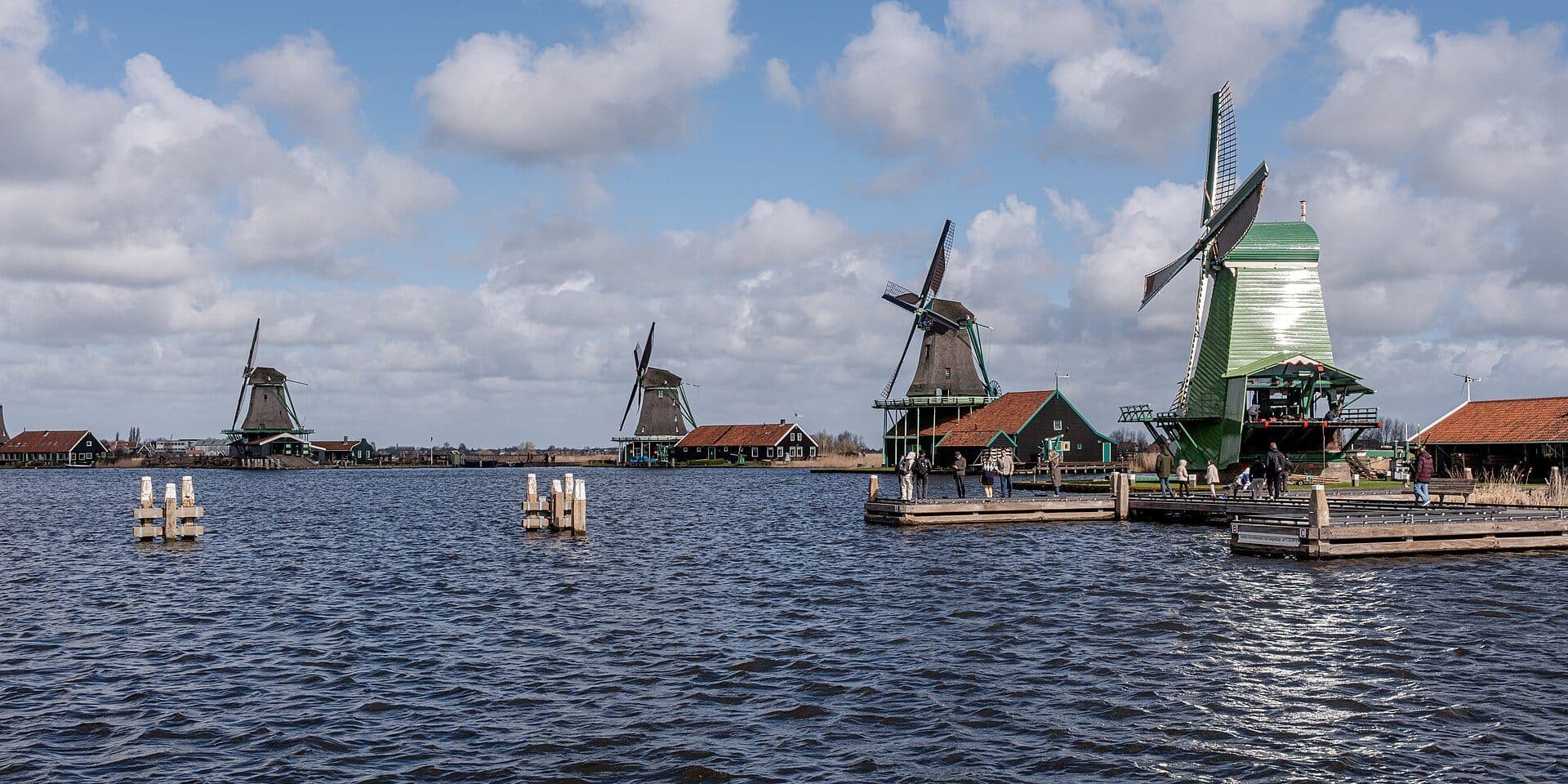
Zaanse Schans: 68 minutes, and the windmills
17 minutes to Zaandijk Zaanse Schans and 17 on foot across the river. The most photographed day trip from Amsterdam is also the second cheapest in travel time, which is worth knowing before booking a coach for it.
The fare is 4,20 euros each way. That is the number the whole day trips guide is built around, and it is the largest gap on this site between what a place costs to reach and what it is sold for.
Utrecht: 78 minutes, and a whole city
26 minutes by direct train and 13 on foot to the Domplein. Utrecht is the one entry near the top of this table that is a full city rather than a village: 360,000 people, its own cathedral tower and a canal system on two levels.
If the reason you want a third day is that two days of Amsterdam left you wanting more city rather than less, this is the trip on the list that answers that.
If you would rather not leave Amsterdam
There is a perfectly good third day inside the city, and it is made of exactly the four stops that a two day itinerary has to cut. We ran them through the same walking matrix and the same optimiser.
A third day without leaving the city
| Time | Stop | Walk from previous |
|---|---|---|
| 09:30 | A'DAM Lookout | start |
| 11:00 | Amsterdam Centraal | 12.0 min |
| 12:00 | Bloemenmarkt | 21.2 min |
| 14:00 | Albert Cuypmarkt | 19.6 min |
Swipe to see the rest of the table.
Walking times and distances: OpenRouteService on the OpenStreetMap walking network, from the same 14 point matrix as the two day itinerary, 15 September 2026. The order is the shortest of all 24 possible, tested exhaustively. Times of day are our proposal, not a measurement.
52.8 minutes of walking in that order. 118 in the worst order of the same four stops, which is 9.43 km against 4.2. With four stops you are already playing for over an hour, because the A'DAM Lookout is across the water and everything else is not.
One warning on that first leg. The 12 minutes from the A'DAM Lookout to Centraal cross the IJ on the Buiksloterweg ferry, and the routing engine treats the crossing as though it were a street: it counts no waiting and no sailing time. The ferry is free and runs constantly, but read that 12 as twelve plus a boat. It is the same caveat that applies to staying in Noord in the accommodation guide.
Going to the Lookout first is what makes the day work: it means the crossing happens once, at the start, instead of being a return leg in the middle.
What the itineraries that rank do with day three
The current first result spends its third day on the Bloemenmarkt, De Pijp and the Heineken Experience. The third result, written by a resident, spends it in Noord and the western islands. Both are reasonable days out. Neither leaves the city, and neither tells you what it costs in time to do so.
So the gap on this search is not quality, it is arithmetic. Between 10,135 words of the two best ranking pages there is not one figure you could plan around, and the question a third day actually poses, can I get to Giethoorn and back and still see it, is answered in a comment thread.
Every number on this page is one subtraction away from two datasets we already published: the train and walking times in the day trips guide, and the daylight hours in the guide to when to go. If you disagree with our conclusion you can still use the table, which is the point of printing it.
Is three days enough
Three days covers the three big museums, the old centre, and one trip out, and that is a complete visit by any reasonable standard. The walking is not what limits you: 74.8 minutes across the first two days and 52.8 more if the third stays in the city.
What three days does not give you is two day trips. Taking both Giethoorn and a second destination means dropping a museum, and in the winter half of the year the daylight makes that decision for you before your preferences do.
What this page does not tell you
It does not tell you how long to spend in any of these places. The last two columns of the main table are the time available, which is arithmetic, not the time needed, which is a matter of taste. Three hours in Utrecht might be plenty or half of what you wanted.
It uses daylight as the budget, which is right for villages and canal paths and wrong for a city with museums open until six. Read the December column as the constraint on what you will see outdoors, not as a closing time.
And it assumes the fastest journey we found on one fixed departure. Sunday timetables, engineering works and a slow connection all make these numbers worse, never better. Treat the travel column as a floor.
Questions people actually ask
Is 3 days enough for Amsterdam?
Yes, and the third day is what makes it worth the extra night: two days covers the museums and the old centre, and the third buys you either a day trip or the parts of the city that did not fit. The walking in the city is not the limit. Two days comes to 74.8 minutes on foot between stops and a third city day adds 52.8 more.
What should I do on the third day in Amsterdam?
Take a day trip, and pick it by how much daylight it leaves you rather than by how it sounds. Haarlem costs 52 minutes of travelling there and back, Zaanse Schans 68, Utrecht 78 and Giethoorn 320. In December, when Amsterdam has 7.7 hours of daylight, that last one leaves you 2 hours 22 minutes in the village.
Can you do Giethoorn as a day trip from Amsterdam?
In summer, comfortably: June has 16.8 hours of daylight, so the 5 hours 20 minutes of return travel still leaves 11 hours 28 in the village. In December it does not really work independently, because 7.7 hours of daylight minus that journey leaves 2 hours 22. This is the one destination where an organised coach genuinely buys you something.
What is the best day trip from Amsterdam for one day?
On time alone, Haarlem: 15 minutes on the train, 11 minutes on foot to the Grote Markt, so 52 minutes of travel for the whole return journey. Zaanse Schans is 68 and Utrecht 78, and Utrecht is a full city rather than a village. All three leave you more than six hours of daylight even in December.
Do I need a third day in Amsterdam if I have already seen the museums?
Only if you want to leave the city or see the parts of it that a two day itinerary cuts. The four stops that do not fit in two days, the A'DAM Lookout, Centraal itself, the Bloemenmarkt and the Albert Cuyp market, make a 52.8 minute walking day in the right order and 118 minutes in the wrong one.
Diego Fresno
Writer and editor, The Amsterdam Travel Guide
I am Diego Fresno. I spent five days in Amsterdam in November, which is enough to have opinions about the light and not enough to have them about Giethoorn, where I have never been. So this page is a subtraction between two datasets rather than a memory: the railway's own timetable and the position of the sun. If you reproduce these numbers and get something different, write to hola@diegofresno.com and I will correct the page and say what it used to say.
- Verified for this page
- The train times and fares for all ten destinations, from the official NS journey planner on 13 September 2026 for one fixed departure. The walk from each arrival station to the town's central point, from OpenRouteService on the OpenStreetMap network on 15 September 2026. The daylight hours, calculated with the NOAA solar algorithm for the 15th of each month. The third day city route, ordered by testing all 24 possible orders against the same walking matrix. The price, duration, rating and review count of the Giethoorn tour, on Viator on 13 September 2026.
- Not verified
- How long any of these places is worth. The time in destination is a subtraction, not a recommendation. Whether the ferry wait makes the A'DAM Lookout leg longer than 12 minutes, which it does, by an amount we have not timed. The Museumkaart price, which we could not read on its own site without entering the purchase flow. And we have not taken the Giethoorn tour linked above, or any of these day trips ourselves.