
The short answer
You cannot buy a ticket whenever you like, and that is the whole difficulty. Every Tuesday at 10:00 CEST the museum releases the week falling six weeks later, and nothing else appears in between. No door sales, no waiting list, no exceptions.
- A grey day in the calendar means two opposite things. Either it sold out, or it has not been released yet, and the calendar shows both the same way. Everything past 8 November 2026 is the second kind.
- 20 of the 46 bookable days were sold out, 43 per cent, but not the nearest ones: 5 to 20 October was gone entirely while the following ten days were open.
- Take the evening if you are booking early. It opens until 22:00, alone among the big three. At 46 days out the evening had 743 places free; at five days out it had none at all.
- It is the cheapest of the three, at 16,50 EUR, against 25 at the Rijksmuseum and the Van Gogh. The audio guide is included rather than 3,75 extra.
When tickets appear, and why the calendar lies to you
The rule is short: Every Tuesday at 10:00 CEST, all tickets for a visit six weeks later go on sale. That is the only moment new dates enter the system. The museum adds, in its own words: “If there are no more tickets available on the selected date, we are sold out. There is no waiting list for tickets.”
Here is the part that sends people away thinking there is nothing: a greyed out date can mean sold out, or it can mean not yet on sale, and the calendar draws them identically. On the morning of 23 September the last bookable day was 8 November 2026. Everything after it was grey, and none of it was sold out. It simply did not exist yet, and would start appearing the following Tuesday.
So the two situations need opposite responses. If your date is inside the window and grey, it is gone and no amount of refreshing will change that, because there is no waiting list. If your date is beyond the window, you are not late, you are early, and the thing to do is work out which Tuesday releases it and be there at ten.
What was actually available, day by day
We walked the official calendar on the morning of 23 September and recorded every day in the window. This is not a sample or an impression, it is the whole 46 days.
The booking window on 23 September 2026
| Dates | Days | Status |
|---|---|---|
| 24 September | 1 | Closed |
| 25 to 27 September | 3 | Sold out |
| 28 to 30 September | 3 | Available |
| 1 to 4 October | 4 | Available |
| 5 to 20 October | 16 | Sold out |
| 21 to 30 October | 10 | Available |
| 31 October | 1 | Sold out |
| 1 to 8 November | 8 | Available |
Swipe to see the rest of the table.
Availability: the museum's own booking calendar, walked day by day on 23 September 2026, checking after each click that the confirmed date had actually changed. Slot counts are the figures the shop itself prints next to each 15 minute slot, with "50+" counted as 50, so the totals are floors rather than exact numbers. This is one snapshot from one morning: the release moves every Tuesday, so the exact dates will be different when you look, and what should hold is the shape.
25 days available, 20 sold out, one closed for maintenance. What is worth noticing is the shape rather than the total. A sixteen day block in the middle of October had gone completely while the ten days after it were open, which means the usual advice, that the sooner your date the worse your chances, is not what the calendar shows. The last week of October was easier to book than the middle of the month.
How many places are left, counted
This museum does something the other two do not: its shop prints the number of places left next to every single time slot. There are 48 of them a day, one every fifteen minutes from 09:00 to 20:45. So instead of estimating, we counted two days: the nearest one with any availability, and the furthest one in the window.
Two days counted slot by slot
| Monday 28 September | Sunday 8 November | |
|---|---|---|
| Days ahead | 5 | 46 |
| Places left in the whole day | 260 | 1,752 |
| Slots sold out, of 48 | 26 | 1 |
| Places left after 17:00 | 0 | 743 |
| Average places, on the hour | 4.8 | 26.5 |
| Average places, the other slots | 5.6 | 39.8 |
Swipe to see the rest of the table.
Availability: the museum's own booking calendar, walked day by day on 23 September 2026, checking after each click that the confirmed date had actually changed. Slot counts are the figures the shop itself prints next to each 15 minute slot, with "50+" counted as 50, so the totals are floors rather than exact numbers. This is one snapshot from one morning: the release moves every Tuesday, so the exact dates will be different when you look, and what should hold is the shape.
1,752 places against 260, which is 6.7 times as many, for the same museum on the same kind of day. That is the value of booking on the Tuesday rather than hoping later, stated as a number rather than as advice.
One smaller pattern, and it is the same one we found at the Van Gogh Museum: the slots on the hour go before the others. On the November date, slots starting on the hour averaged 26.5 places against 39.8 for the quarter, half and three quarter past, and the only sold out slot in the entire day was 10:00. People ask for round numbers in both museums.
What it costs
Admission, from the museum's own shop
| Ticket | Price |
|---|---|
| Adult | 16,50 EUR |
| 10 to 17 years | 7,00 EUR |
| 0 to 9 years | 1,00 EUR |
| Museumkaart, ICOM, Stadspas | 1,00 EUR |
| European Youth Card | 7,00 EUR |
| Introductory programme, on top | 7,00 EUR |
Swipe to see the rest of the table.
Prices, opening hours, closures and sale rules: the museum's own pages, annefrank.org and its ticket shop at tickets.annefrank.org, read on 23 September 2026. Every price includes the 1,00 euro booking fee the museum adds.
Every figure above includes the 1,00 EUR booking fee the museum adds, which is why even a free entry costs one euro. Nothing here is free, not even for a toddler or a Museumkaart holder, and that is unusual: the same card gets you into the Rijksmuseum and the Van Gogh for nothing.
The I amsterdam Card and the Student card give no discount whatsoever here. The I amsterdam Card is worth paying attention to because it does cover the Rijksmuseum in full, so it is easy to assume it covers this too. It does not, and the museum lists it explicitly among the cards that get nothing.
Against the other two big museums
We have now measured all three the same way, and the comparison is not the one most itineraries assume.
The three big Amsterdam museums, each measured on its own booking system
| Anne Frank House | Rijksmuseum | Van Gogh Museum | |
|---|---|---|---|
| Adult ticket | 16,50 EUR | 25,00 EUR | 25,00 EUR |
| Under 10 | 1,00 EUR | Free | Free |
| With a Museumkaart | 1,00 EUR | Free | Free |
| Audio guide | Included | Not sold | 3,75 EUR |
| Closing time | 22:00 | 17:00 | 18:00, 21:00 on Fridays |
| Time slots in a day | 48 | 8 | 31 |
| Tickets at the door | Never | A limited number | No |
| How far ahead you can book | 46 days, in weekly batches | Months | Months |
| Days sold out in that window | 20 of 46 | None | Same day mostly gone |
| If your plans change | No refund, no change | Rebooking if a slot is free | No refund |
Swipe to see the rest of the table.
Anne Frank House measured on 23 September 2026; Rijksmuseum and Van Gogh Museum on 22 September 2026, each on its own ticket shop and by the same method of walking the calendar and counting.
The cheapest of the three is the one you have to plan around, and the two expensive ones are the flexible ones. The Rijksmuseum never sold out on any date we checked and will try to rebook you. This one is 8,50 euros cheaper and, if you have not booked six weeks out, may simply not be possible on your dates. That is the opposite of how people budget a trip, and it is why this is the first thing to book rather than the third.
Opening hours and closures
09:00 to 22:00, every day, which is the widest window of any major museum in the city. A visit takes about 1 hour and the audio tour is included in the ticket. There is also an optional 30 minute introductory programme in English, for ages 10 and up, at 7,00 EUR on top.
Days that are not 09:00 to 22:00
| Date | Hours |
|---|---|
| 21 September 2026 | Closed, Yom Kippur |
| 22, 23 and 24 September 2026 | Closed for maintenance work |
| 1 January | 12:00 to 22:00 |
| 27 April, King's Day | 09:00 to 17:00 |
| 4 May | 09:00 to 17:00 |
| 7 November 2026 | 09:00 to 18:30 |
| 25 December | 09:00 to 17:00 |
| 31 December | 09:00 to 17:00 |
Swipe to see the rest of the table.
The museum's own opening hours page, read on 23 September 2026. Dates without a year repeat annually.
What the museum itself warns you about
“Please note that there are fraudulent websites with URLs similar to the one used by the Anne Frank House. These sites are aimed at credit card fraud or the sale of invalid tickets. Commercial parties offering Anne Frank House tours do not provide access to the Anne Frank House.”
That is on the museum's own booking page, and it is the reason there is no tour recommendation anywhere on this page. This site earns a commission on tour bookings and says so on every other guide it publishes. Here there is nothing to earn it on, because the only thing that gets you through that door is a ticket from annefrank.org, and the museum is explicitly telling you that products sold as Anne Frank House tours do not.
Walking tours of the Jordaan that pass the building are a real and perfectly honest thing to buy, and some are good. They are not this, and a listing that blurs the two is the problem the museum is describing.
Four museum rules that can stop you at the door
A ticket is not the last hurdle. The museum publishes these across three separate pages, which is how people end up turning a six week wait into a wasted morning.
Rules worth knowing before you set off
| Rule | What it actually means |
|---|---|
| Minimum age 10, and it is a recommendation rather than a door policy | The museum states it maintains a minimum age of 10 and that it is not suitable for younger children, then adds that parents must judge for themselves. It does sell a 0 to 9 ticket, so the two things coexist: the price list lets a younger child in, the museum asks you to think hard first |
| Bags bigger than a sheet of A4 cannot come in | There is a cloakroom for coats and buggies, but no room for large bags, backpacks or suitcases. The museum's own wording is that otherwise you may not be able to visit, so arriving from the station with luggage is a real risk |
| No photography or filming anywhere inside | To protect the original items and not disturb other visitors. The ban covers smart glasses, camera glasses and AI glasses, which is unusually specific and suggests they have had to say it |
| Steep stairs, small rooms, and not all of it accessible | It is a seventeenth century canal house and the museum says so plainly: if you have difficulty walking you may struggle with the stairs. They offer support and alternatives for visitors with a disability, which is worth arranging in advance |
Swipe to see the rest of the table.
Museum rules, access, opening information and audio tour details read from annefrank.org on 8 October 2026, from its practical information, visiting with children and accessibility pages.
Getting there, and the tram that is not running
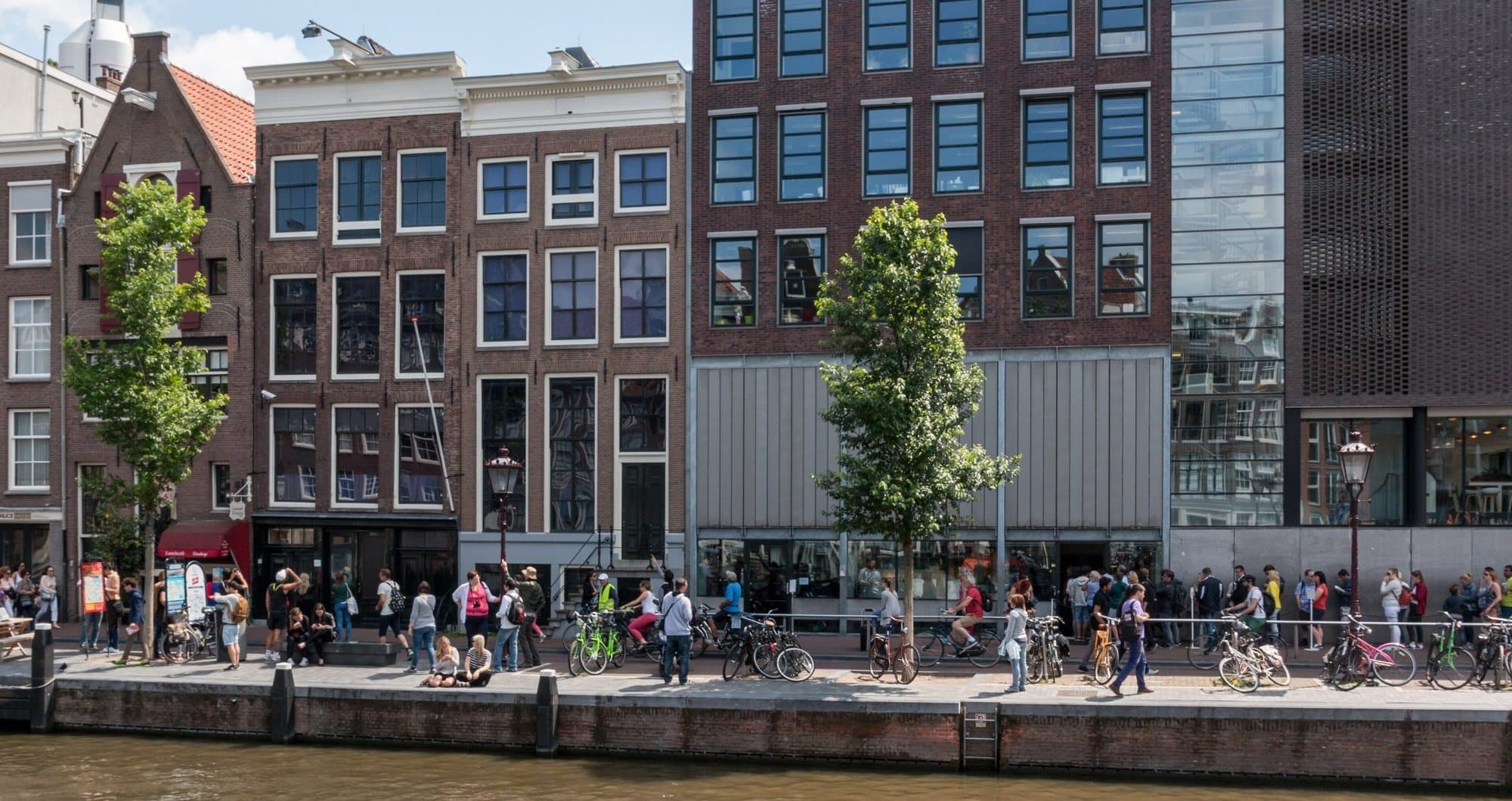
The house is at Prinsengracht 263-267, but the entrance is round the corner at Westermarkt 20, around the corner from the house itself. There is no tram to the Westermarkt stop until February 2028, because of works that started in February 2025. Trams still run as far as Dam Square, which leaves 10 minutes on foot, or 20 minutes if you walk the whole way from Centraal. Directions written before the works still tell you to take the tram to the door.
Inside, the museum says a visit takes about an hour on average and you can take as long as you need. The audio tour is included in the ticket and runs in 9 languages. There is a separate one for children aged 10 to 15, Anne's Story, told from Anne's point of view. The cafe and shop can only be reached from inside the museum and both take cards only.
Why the family did not simply leave Amsterdam
This is the question people ask most often about the house, and it carries an assumption worth correcting: that they did not try. They tried for four years. The museum and the United States Holocaust Memorial Museum published joint research into it in 2018, and the sequence is this.
Otto Frank's attempts to get his family out
| When | What happened |
|---|---|
| 1938 | Otto Frank starts working on plans to emigrate to the United States |
| 14 May 1940 | The US consulate in Rotterdam, the only one in the Netherlands that issued immigration visas, is destroyed in the bombing. The waiting list has to be rebuilt and every application resubmitted, Otto's included |
| 30 April 1941 | Otto writes to his American friend Nathan Straus: 'I am forced to look out for emigration and as far as I can see the USA is the only country we could go to' |
| 1941 | The United States closes the German consulates; Nazi Germany closes the American consulates in Germany and occupied territory |
| December 1941 | After Pearl Harbor, transatlantic shipping is suspended and the fallback route through Cuba becomes impossible |
| 6 July 1942 | The Frank family goes into hiding in the Secret Annex. Going into hiding was what was left |
Swipe to see the rest of the table.
From the joint research by the Anne Frank House and the United States Holocaust Memorial Museum into Otto Frank's attempts to emigrate, published by the museum on 6 July 2018 and based on the YIVO Institute dossier together with new Dutch and American sources.
The finding that reframes it is the museum's own: the Franks were never refused entry to the United States. Otto's visa application was never processed at all. A bomb destroyed the one consulate in the country that could issue it, the waiting list was rebuilt from scratch, and then the consulates closed and the shipping stopped. Going into hiding on 6 July 1942 was what was left after everything else had been tried.
Eight people lived in the Annex for 761 days: the Frank family first, the Van Pels family a week later, and Fritz Pfeffer four months after that. Knowing the number before you climb the stairs changes what the rooms feel like, which is the one thing a page like this can usefully do from a distance.