
The short answer
The best month to visit Amsterdam is June. It averages 8.6 days of rain and 250 hours of sunshine, within a whisker of the driest and sunniest months of the year, and it is the least crowded month between April and October on Dutch hotel occupancy figures.
- Go in June. It is as dry as April, nearly as sunny as May, and the least crowded month between April and October.
- Avoid October. It has almost exactly April's crowds with 13 rain days instead of 8.5, and half the sunshine.
- Shifting a month barely helps with crowds. Between April and October the occupancy index only moves from 84 to 100. For a genuinely empty city you need January.
Read five guides on when to visit Amsterdam and you will find the same advice: come in spring for the tulips, or in September and October for the shoulder season. What you will not find in any of them is a single number for how crowded those months actually are, or how often it actually rains.
That gap is the whole reason this page exists. The Dutch keep excellent records and publish them for free. The national weather service has the daily observations from Schiphol going back decades, and the national statistics office publishes how many people slept in an Amsterdam hotel every single month. Nobody seems to have put the two next to each other.
So we did. What comes out disagrees with the consensus on two of its three main claims.
Amsterdam month by month, measured
Everything below is calculated, not copied. The rain days are counted one day at a time from the daily record, using the standard threshold of one millimetre. The occupancy index sets the busiest month of the year at 100 so you can compare months without needing to hold seven-figure numbers in your head.
Weather and crowds, month by month
| Month | Avg high | Rain days | Sun hours | Occupancy (100 = busiest) |
|---|---|---|---|---|
| January | 7.0 °C | 13.8 | 63 | 56 |
| February | 8.3 °C | 11.4 | 107 | 60 |
| March | 11.0 °C | 9.8 | 169 | 76 |
| April | 14.3 °C | 8.5 | 222 | 92 |
| May | 18.4 °C | 8.5 | 254 | 90 |
| June | 21.8 °C | 8.6 | 250 | 89 |
| July | 22.9 °C | 10.5 | 238 | 100 |
| August | 23.2 °C | 10.1 | 221 | 99 |
| September | 20.2 °C | 10.9 | 179 | 84 |
| October | 15.5 °C | 13.0 | 117 | 91 |
| November | 10.7 °C | 15.7 | 75 | 80 |
| December | 8.4 °C | 13.8 | 52 | 77 |
Swipe to see the rest of the table.
Climate: KNMI station 240 (Schiphol), daily record 2015 to 2025, 4,018 days. Monthly means and rain-day counts calculated by us; a rain day is 1.0 mm or more. Consulted 13 September 2026. Occupancy: Statistics Netherlands (CBS) StatLine table 82061NED, municipality of Amsterdam, monthly hotel overnight stays, average of 2022 to 2025. Consulted 13 September 2026.
June is the month nobody names
June has 8.6 rain days, within a tenth of April and May, the two driest months of the year. It has 250 hours of sunshine, four short of May's annual peak. And it is the least crowded month of the entire April to October stretch, at 89 against April's 92, May's 90, July's 100 and October's 91.
Dry, sunny, warm enough for the terraces at 21.8 degrees, and emptier than the months either side of it. On the numbers there is no argument: if you can choose, choose June.
The reason it gets skipped is probably that it falls between the two things guides are built around. It is after the tulips, so the spring articles ignore it, and before the school holidays, so the summer articles ignore it too. Of the six editorial guides ranking for this search, only one mentioned June at all.
If you do get a wet day
Eight or nine rain days a month means that even in the best month you have a reasonable chance of one. The thing worth knowing is that a walking food tour is the activity least ruined by it: you are outside for ten minutes at a time between indoor stops, and they run in the rain.
There are three small group food tours in Amsterdam with more than two thousand reviews each. We put them side by side rather than picking one, because the comparison turns out to be unusually one-sided.
The three main Amsterdam food tours compared
| Tour | Price | Duration | Rating | Reviews |
|---|---|---|---|---|
| Food and Cultural Tour, 10 tastings | 79 EUR | 3 h 30 | 4.98 | 6,335 |
| 10 Tastes of Amsterdam | 94 EUR | 3 h 00 | 4.92 | 4,307 |
| Jordaan Food Tour | 109 EUR | 3 h 00 | 4.89 | 2,683 |
Swipe to see the rest of the table.
Prices, durations, ratings and review counts read from Viator on 13 September 2026. Prices are the from-price per adult in euros and change with date and availability.
The cheapest of the three is also the highest rated, the most reviewed and the longest by half an hour. Paying thirty euros more gets you a shorter tour with 42 per cent as many reviews behind it. That is not the result we expected and we are not going to dress it up.
October is the worst trade in the calendar
October runs at 91 on the occupancy index. April runs at 92. In terms of how many people are in the city, they are the same month. The weather is not remotely the same.
April has 8.5 rain days and 222 hours of sun. October has 13 rain days and 117 hours of sun. You get April's crowds with something much closer to November's weather: it rains on roughly two days in five, and the amount of daylight you can actually use collapses.
If someone has told you October is a clever shoulder-season choice for Amsterdam, the occupancy figures do not support it. It is a busy month that happens to be wet.
September is wetter than July
This one caught us out, because we had written the opposite before checking. September averages 93 mm of rain across 10.9 days. July averages 67 mm across 10.5 days. September also has 179 hours of sun against July's 238, a difference of nearly two hours a day.
September does have a real argument in its favour, and it is the honest one: at 84 it is genuinely the quietest month of the warm half of the year. If what you want is fewer people and you do not mind the weather turning, it earns its reputation. Just not for the reason it usually gets given.
Changing month barely fixes the crowds
The busiest month of the year, July, sees 2.02 million hotel overnight stays. The quietest, January, sees 1.13 million. That is a ratio of 1.79 to one across the whole calendar, which is a much flatter curve than the advice implies.
Narrow it to the months most people will actually consider, April to October, and the index only moves between 84 and 100. Shifting your trip from July to September buys you a sixteen per cent reduction in the number of people in town. It does not buy you an empty Rijksmuseum.
The honest version of the crowd advice is this: if you want Amsterdam genuinely quiet, go in January or February and accept about eight hours of daylight and rain on one day in two. Everything between April and October is a busy city.

What the tulip season actually is
Keukenhof opens for about eight weeks and closes for forty-four, and that constraint governs the whole spring. But the fields most people are picturing are not inside the gardens: they are the commercial bulb fields around Lisse and Hillegom, and they peak on temperature, not on the calendar.
A warm March can put the best week in early April; a cold one can push it past the closing date. April being the driest month of the year helps, but booking a tulip trip more than about six weeks out is a bet on the weather rather than a plan.
The one date to check before you book
King's Day, 27 April, is the largest street party in the country. If that is what you came for it is superb. If it is not, you have booked a city break into a festival: the canals close to normal boat traffic, the museums keep shorter hours, and rooms are gone months in advance.
It sits inside the driest, brightest fortnight of the Amsterdam year, which is exactly why it catches people out. Check the date against your dates before anything else.
Questions people actually ask
What is the cheapest month to visit Amsterdam?
January and February are the quietest by a wide margin, and quiet is what drives price down: hotels take 1.13 and 1.22 million overnight stays against 2.02 million in July. We do not publish room rates here because we have not found a rate source we can reproduce, and a price we cannot check is not worth printing.
Is September really the best shoulder month?
Not on the weather. September averages 10.9 rain days against April's 8.5, and 179 hours of sun against May's 254. It is genuinely quieter than April, at 84 on our occupancy index against 92, but you pay for that with the wettest stretch of the year starting.
How bad is the rain in Amsterdam?
It depends enormously on the month, which is the part most guides skip. November has 15.7 days with a millimetre of rain or more, so it rains on roughly one day in two. April has 8.5. That is not the same city to walk around in.
When do the tulips bloom?
The fields around Lisse and Hillegom typically peak somewhere between mid April and the first days of May, but it is driven by temperature and it moves year to year. Keukenhof publishes its opening dates in advance; the fields do not follow them.
Is it worth avoiding the crowds by shifting a month?
Less than you would think. Across April to October the occupancy index only moves between 84 and 100. If you want a genuinely empty Amsterdam you have to go in January or February and accept eight hours of daylight.
Diego Fresno
Writer and editor, The Amsterdam Travel Guide
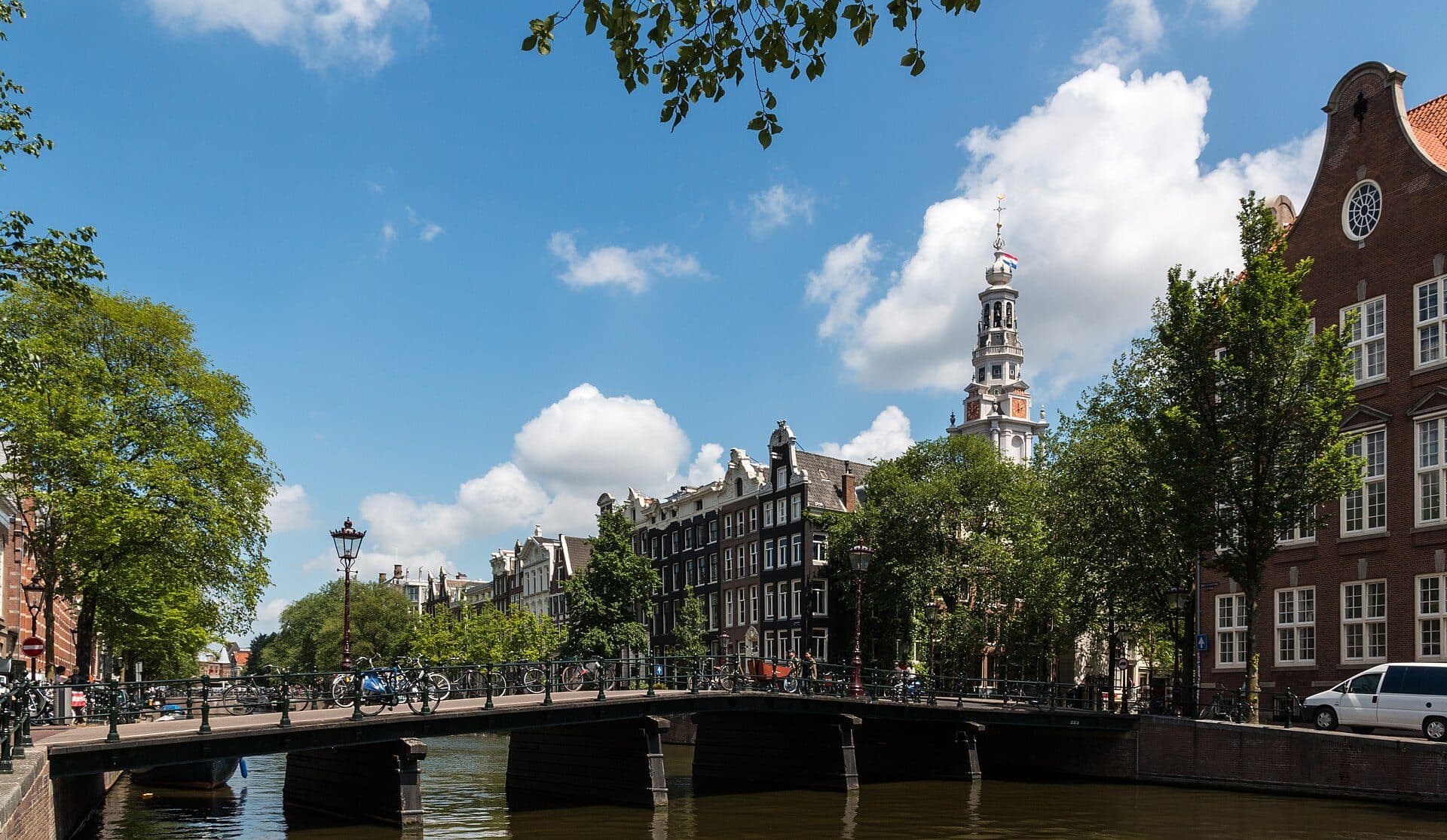
I am Diego Fresno. I have been to Amsterdam and the photograph on this page is mine, taken on 16 November 2018. What I can do beyond that is measure, and everything above comes from two public Dutch datasets that anyone can download and check. If you reproduce these numbers and get something different, write to hola@diegofresno.com and I will correct the page and say what it used to say.
- Verified for this page
- The Dutch daily climate record for Schiphol, 2015 to 2025, 4,018 days, from which we calculated every monthly figure on this page including the rain-day counts. Monthly hotel overnight stays for the municipality of Amsterdam from CBS StatLine, 48 months, 2022 to 2025. Prices and review counts for the three food tours, on Viator, 13 September 2026.
- Not verified
- Room rates. We could not find a hotel price source we were able to reproduce, so this page contains no price figures at all rather than an estimate dressed up as data. We have also not been in Amsterdam in every month of the year: everything seasonal here is measured from the record, not remembered from a visit. And we have not taken the food tour linked above.